Sawyer Accelerates the Fight Against Childhood Malaria
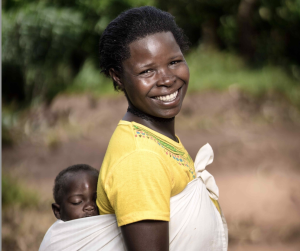 When Ross Boyce, MD and his research team announced in the New England Journal of Medicine that treating a simple cloth wrap—traditionally used by mothers to carry young children—with permethrin could reduce malaria infections by nearly two‑thirds, the global health community took notice. With malaria rates on the rise due to pyrethroid resistance in mosquitos, permethrin-treated wraps may become an important tool to lower the incidence of childhood malaria, which causes more than 500,000 deaths among young children each year.
Boyce, an associate professor in the UNC School of Medicine’s Division of Infectious Diseases and a leading researcher at UNC’s Institute for Global Health and Infectious Diseases, brings a rare combination of experiences that uniquely position him to ask a key question. Serving in the military, Boyce recalled treating his uniforms prior to his first deployment to Iraq. Later, as a resident training in Kasese, Uganda, he cared for many patients with malaria and wondered if treated fabrics could repel mosquitos and lower rates of infection, especially during the day when people are not protected by a net.
Fast forward to 2022, when Boyce and his co-lead investigator, Edgar Mulogo, professor of public health at Uganda’s Mbarara University of Public Health and Technology, put the idea to the test.
Study Shows Dramatic Reduction in Malaria Infections
In a groundbreaking study conducted in a rural region of western Uganda, 400 mothers with young children joined a double-blinded, randomized, placebo-controlled trial. Children in the intervention group were carried in treated fabrics wraps, while children in the control group received untreated wraps. Both groups were also given new bed nets. The permethrin solution used to treat the wraps was provided at no cost by a U.S.-based company, Sawyer Products.
At the outset of the study Boyce’s team was optimistic that the intervention would reduce malaria among children with treated wraps, but because most bites were thought to occur at night, they weren’t sure of the potential impact. The actual results, with 66% fewer malaria infections, far exceeded expectations, and suggested that outdoor biting was more important than they realized.
Sawyer Steps Up to Speed Progress
Now Boyce is poised to build on the trial’s success, thanks to a recent $500,000 gift from Sawyer, a company that has long been recognized internationally for their commitment to clean water, insect protection and humanitarian impact. Sawyer manufactures high‑performance outdoor protection gear such as water filtration systems, insect repellents, permethrin fabric treatments and other items to keep people safe in demanding environments. Their generous funding of Boyce’s malaria prevention research reflects this long-standing commitment to practical, scalable tools that save lives and strengthen communities.
This gift—one of the most significant private investments to date in Dr. Boyce’s malaria‑prevention research—will accelerate the next phase of turning the study’s success into real‑world implementation.
“Sawyer’s commitment allows us to accelerate the crucial work of moving this concept from research to practice. Given the simplicity, low cost, and effectiveness of the treated wraps, figuring out how to get them into the hands of mothers across the globe is a pressing issue,” said Boyce.
A child dies from malaria almost every minute, he said, stressing the critical advantage of gifts like Sawyer’s, compared with the time-consuming process of grant writing. “This gift not only recognizes that dilemma but puts action behind it.”
Sawyer’s investment will jumpstart a series of projects to examine how treated wraps can reach mothers and babies sustainably, affordably and safely across diverse settings. New pilot study sites will gather information to better understand long-term impacts and effectively plan for distribution, training needs, community outreach and more.
Filling a Crucial Protection Gap
Boyce sees the wraps as a key new tool in the malaria-reduction toolbox, bolstering the use of bed nets, vaccines and indoor spraying. Simple as they are, the wraps do more than introduce a new idea — they fill a crucial protection gap, safeguarding infants and very young children during the vulnerable months before vaccines can provide meaningful immunity. Permethrin wraps offer a low-cost, easy-to-use intervention, with the potential to transform child health wherever malaria threatens young lives.
“Sawyer is very excited to participate in the next phase of Dr. Boyce’s research,” said Kurt Avery, the company’s founder and president. “We supplied a similar treatment to the Department of Defense for decades and always believed that it could be used to benefit individuals and communities, as well.”
Dr. Boyce’s work not only gives this dream credibility, he said, but a strong framework to turn research into action. Avery is eager to see results from the next round of research, especially any insights on the best process for treating the wraps to achieve maximum impact. “We will work to distribute these treatments as soon as possible, as the need is urgent,” said Avery.
The story of permethrin‑treated wraps shows what is possible when curiosity meets cultural understanding, and inspired science meets a company that cares. With Sawyer’s $500,000 gift, Boyce and his team are poised to accelerate one of the most promising malaria‑prevention tools in years. Their gift will advance the findings of this landmark study—and help ensure that mothers and children do not have to wait years for protection that could save lives today.
To learn more about this initiative, please reach out to Jinhee Lee, Director of Development, Corporate and Foundation Relations, UNC Health Foundation, at (856) 534-0140 or [email protected].